

The Original Stewards: Black and Indigenous Contributions to Oregon's Soil Health
Stories of observation, knowledge, and connection
Written by Sage Fairman. Video by Sola Films.
"I want the soil to be healthy, whether I'm harvesting from it or not. Healthy soil, healthy people." –Malcolm Hoover, Black Futures Farm
OrCAN sat down with Michelle Week, and with Mirabai Collins and Malcolm Hoover, to talk about soil health, community, and what it means to farm with knowledge that goes beyond this lifetime. Their interviews highlight how soil health practices are not new, and Indigenous and Black communities have long understood that soil, water, plants, animals, and people are interconnected.
As we face increasing threats from heat domes, drought, floods, wildfires, and unpredictable weather, soil health practices are more important than ever– and these producers are leading the way toward a more resilient future.
“[There are] these common threads among Indigenous people… people are made of clay, or of soil, of this earth. So tending this land caring for the soil is so important because it's part of us.” –Michelle Week, Good Rain Farm

Coming Full Circle
Michelle Week is the steward of Good Rain Farm, or x̌ast sq̓it (hast squeit) in the traditional language of the sngaytskstx (Sinixt) Arrow Lakes Peoples. The farm is tucked into the rainy west side of the Cascades near Troutdale. From stories about marigolds to how we can truly recognize Indigenous contributions to soil health, Michelle speaks to how through connection to a place, we can rebuild a culture of respect, honor, gratitude and reciprocity.
She also reminds policy makers and advocates to prioritize programs like the Farmer & Rancher Disaster Resilience Grant, which effectively supports the working land stewards who make Oregon resilient and feed our communities. Michelle shares:
“The Disaster Resilience Grants are really important because we're going to continue to have really chaotic climate impacts, and farmers need to adapt to those impacts. I'm constantly mitigating risks that are possible, that we've seen happen, and we just don't know when they're going to happen again. And so… to be able to consistently continue to grow vegetables for my community, I have to… prepare for all of the possible 'could be's' because that 'could be' could devastate the farm... We can't financially carry that level of risk. And for... farms like mine that are small, we're often overlooked by the… various programs that are supposed to help us mitigate these risks. So we have to create them at a more local scale in the state, county, and prioritize our farmers and prioritize this work.”
Rooted Knowledge
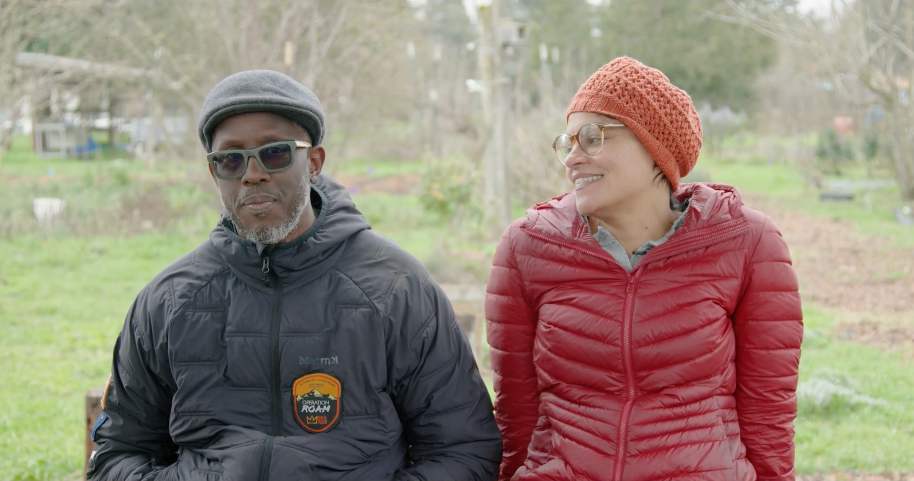
Mirabai Collins and Malcolm Hoover are the co-founders of Black Futures Farm, a Black-led, community-centered urban farm in Southeast Portland. They grow vegetables, fruits, herbs, and above all, community. Mirabai and Malcolm remind us that the solution to a changing climate is not an individual effort, but rather a collective one rooted in observation, curiosity, and ancestral knowledge. Having spaces to learn from one another is vital to restoring the land. Malcolm shares:
“We have to be intentional about it. And we can't feel powerless, but we have to also know that good things have to be modeled and proven for other people to adapt. We have all these things that are proof of concept in hopes that people come, they'll look at it, they'll learn from it, and they'll adapt it and apply it to their own situation.”
They ask us to have an honest conversation about Black agricultural knowledge and its foundational role in shaping agriculture today. Mirabai reflects that when we talk about Black contributions to agriculture, "it's always centered on our labor and not centered on our knowledge and what sorts of practices we brought, in those conditions, to places that were not familiar.”
Watch the video & get involved
When we honor Indigenous and ancestral soil health practices, we’re both restoring land and building a more equitable, resilient future for all. Honoring this legacy is essential to building truly equitable and sustainable food systems. Thank you to Michelle, Mirabai, and Malcolm for sharing their time and knowledge.
Looking for culturally-specific soil health support?
Learn more and get involved with the Soil Health Network.
And join OrCAN's network to engage in our advocacy work.
We work to advance institutionalized support for soil health and climate resilience, and advocate for programs like the Farmer & Rancher Disaster Resilience Grant.
We invite you to watch and share the full-length video below!
Credits
Cinematography: Miguel Iniesta, Sola Films
Farmers: Michelle Week, Good Rain Farm; Malcolm Hoover & Mirabai Collins, Black Futures Farm
Additional footage: East Multnomah Soil and Water Conservation District's Headwaters Business Incubator Program, featuring Silly Goose Farm, Walking Whale Flower Farm, and Cohesive Farm
This video project was made possible with support from the Wildseeds Fund.


Comments